New drones, unmanned ground vehicles and other emerging defence technologies were put to the test in Portugal during EU OPEX, the European Defence Agency's (EDA) flagship operational experimentation campaign. Held with the Portuguese Armed Forces at the Santa Margarida military camp from 21 September to 14 October, it brought European defence innovators together with military users in realistic scenarios.
"Given the deteriorating security environment, Europe must be ready to defend itself. And no single Member State can address the defence innovation challenge alone," said André Denk, Chief Executive of the European Defence Agency.
"That requires well-trained and fully equipped armed forces; a defence industry able to deliver at scale and to sustain high-intensity operations; and the capacity to rapidly adapt to new technologies – in other words, to innovate. EU OPEX brings EU countries together to put this into practice," he added.
Accelerating the adoption of emerging defence technologies by European armed forces is a key objective of the EU's
Defence Readiness 2030 agenda.
For the first time, EU OPEX was integrated into a national military exercise,
ARTEX 26, so companies could test unmanned aerial and ground systems, counter-drone solutions and loitering munitions in demanding operational conditions. The final demonstration on 14 October was attended by more than 400 guests, including the President of Portugal António José Seguro, Portuguese Minister of Defence Nuno Melo and the Chief of Staff of the Portuguese Army, General Eduardo Mendes Ferrão.
BraveTech EU innovators awarded €1.2 million
The campaign also hosted the second phase of BraveTech EU. Four of the six companies taking part, all developing innovative solutions to address battlefield challenges in Ukraine, were awarded €300,000 each (€1.2 million in total). BraveTech EU is an initiative funded by the European Commission and implemented in partnership with EDA and Ukraine’s Brave1 platform, supporting the development of innovative technologies. BraveTech EU aims to strengthen Europe's defence industrial and technological base.
Following an evaluation involving experts from EDA, the European Commission, Brave1, experts from EU Member States and the Portuguese Armed Forces, the four companies were awarded the prize money to develop their technologies ahead of further field experimentation in 2027:
- EdgeX Robotics (Poland): a robust, affordable unmanned ground vehicle.
- Kova Labs (Finland): an autonomous navigation system capable of operating in complex terrain, including forests and obstacle-filled environments.
- Soraccel (France): an AI-driven mission system capable of navigating without GPS.
- Tempterno Defence (Estonia): an affordable rocket system with a launcher that can be mounted on a vehicle or drone.
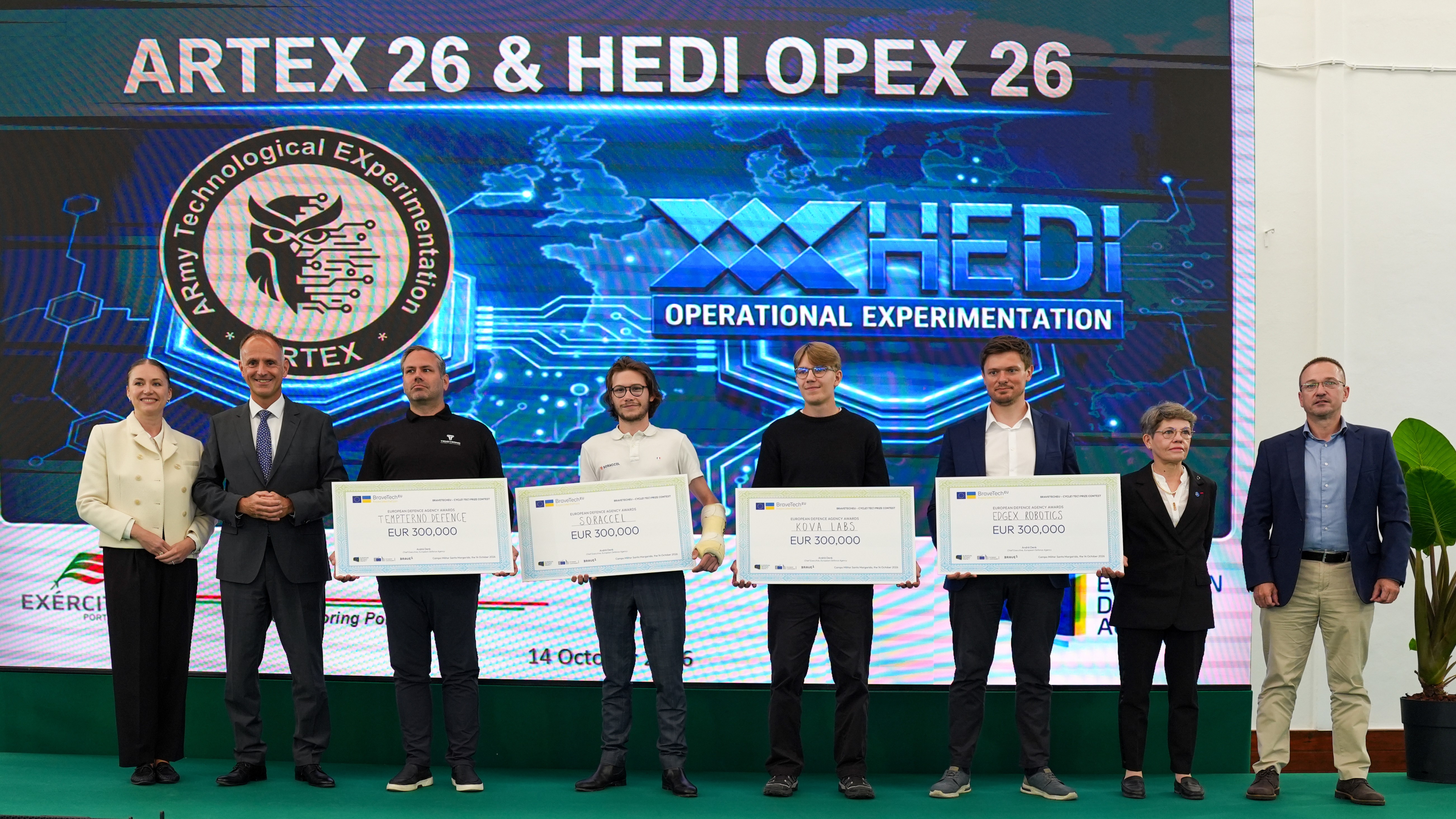
Representatives of the four BraveTech EU companies at the award ceremony
Sentinel Strike: testing loitering munitions
Sentinel Strike is the first loitering munition challenge in Europe providing EU Member States with access to data and hands-on experience. Operating in the military training area, participants were tasked with launching loitering munitions, identifying stationary or moving targets and striking them under demanding conditions. Missions were conducted during both day and night, including scenarios involving denied and contested operational environments.
The winners of the Sentinel Strike Challenge are expected to be announced in early 2027.
Testing emerging technologies in operational conditions
At the EU OPEX 2025 in Italy, three companies were identified as the most promising for specific use cases, involving cross-domain logistics. As a result, in 2026, they were invited to experiment alongside the Portuguese Armed Forces as part of the wider military exercise:
- Schiebel (Austria): heavy-lift vertical take-off and landing unmanned aerial system.
- Beyond Vision (Portugal): low-cost, attritable unmanned aerial system designed for high-risk missions.
- ARX Robotics (Germany): tracked unmanned ground vehicle for military logistics.
Operational experimentation at the heart of EDA's new innovation centre
Operational experimentation will become a central activity of the Centre for European Defence Innovation (CEDI), which will be established within EDA on 1 November 2026.
Approved by EU defence ministers at the
EDA Steering Board on 28 September, CEDI will strengthen the Agency's role in supporting collaborative defence innovation, helping Member States identify, experiment and adopt promising technologies together.
By connecting innovative companies with armed forces and military testing facilities, the centre will help accelerate the development of solutions that respond to Europe's defence capability needs.