The European Union does not lack defence priorities. The challenge is turning them into action. Nine Priority Capability Areas (PCAs) now focus political attention, national plans and investment on the gaps EU leaders consider most urgent, with one goal in mind: defence readiness by 2030. EDA is at the heart of putting PCAs into practice.
What are PCAs?
Priority Capability Areas, or PCAs, are nine areas of European
defence agreed by EU leaders in 2025. They identify areas where shortages are serious, investment needs are large or where countries could gain by working together. The aim is readiness: ensuring that armed forces have not only equipment, but also the people, supplies and organisation needed to act.
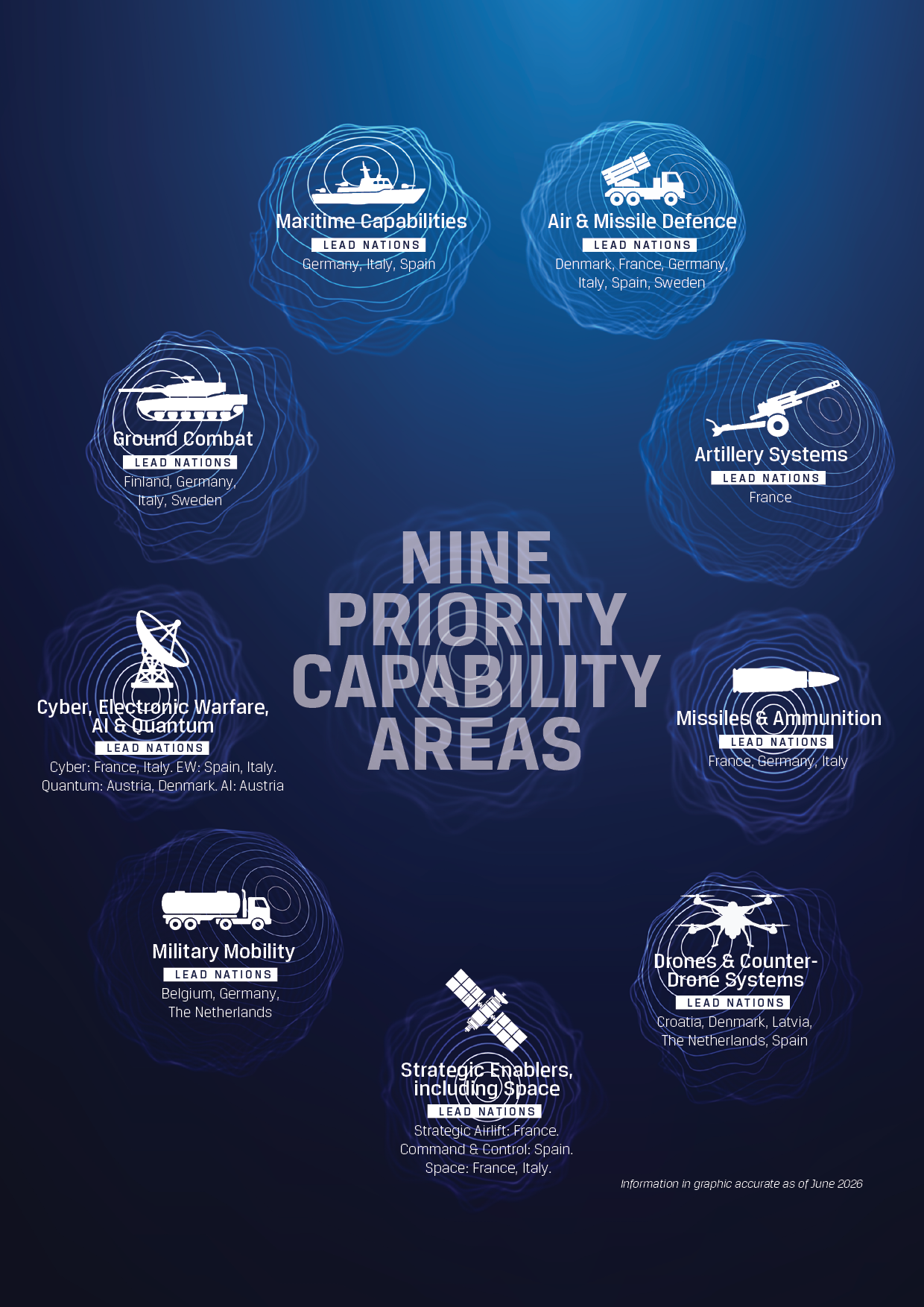
PCAs cover air and missile defence, artillery, missiles and ammunition, drones, military mobility, ground combat, maritime capabilities, strategic enablers and technologies such as artificial intelligence, quantum, cyber and electronic warfare.
It is an imperfect list. Some PCAs cover an entire field, such as the maritime domain, while others focus on a particular weapon or technology. Air combat is not included. That is mainly because the PCAs emerged from European Council conclusions, beginning with seven areas before expanding to nine. They point towards areas where EU leaders want faster progress.
“They reflect leaders’ political focus of the moment: where to put our efforts to achieve defence readiness at EU level by 2030,” says Franck Desit, Deputy Director for Capability, Planning and Armaments at EDA. Vedrana Gujic, a senior EDA policy officer, puts it more succinctly: “PCAs are not a military concept.”
What’s the difference between PCAs and the 22 Capability Development Priorities?
Those priorities were developed from national plans, NATO requirements, lessons from operations, technological change and industrial considerations. They are comprehensive and deliberately not ranked. EDA’s Desit describes them as “the menu”.
To cut a long story short, the original 22 priorities describe what European armed forces may need. The nine PCAs show where EU leaders want faster movement now.
Who’s involved?
Each PCA is led by one EU country or a group of co-leads. They decide which parts of a broad area to pursue. They can bring together other countries that want to participate. The nine PCAs have so far been divided into 14 specific strands of work.
Participation varies. Some groups involve a limited number of countries; others include almost all EU Member States. Cooperation may also involve third countries and partners such as Ukraine or NATO. EDA provides the framework and expertise, while EU funding programmes can support projects. Governments retain control over the work and any resulting purchases.
What’s EDA’s role?
EDA brings together national defence ministries and military experts to compare plans, identify common needs and explore whether countries could develop or buy equipment jointly.
The Agency also connects the PCAs with technical work, working groups, and projects that already existed. This has required some adjustment because the nine areas cut across a system organised around the 22 priorities. EDA’s Gujic acknowledges that the change initially caused some friction. But looking on the bright side, PCAs have also brought something that can accelerate cooperation: money.
Countries that might once have pursued separate national programmes are now forming groups around shared projects. They can expand existing work, launch something new or combine national spending with EU support. EDA can help them develop the project, but the participating governments decide what to pursue and how to fund it.
As PCAs develop, EDA will monitor progress and prepare annual reports, with input from the European Commission, the European External Action Service, and the EU Military Staff. The first annual defence readiness report is due later this year.
What’s next?
The next phase is about projects rather than new lists. Some groups may move towards buying equipment together in the short term. Others will work on systems that could take years to develop.
The first readiness report will show whether the PCAs are beginning to produce measurable progress towards 2030. The assessment will look beyond money spent or contracts signed. As Desit puts it: “Equipment alone doesn’t create readiness.” Armed forces also need trained personnel, logistics, doctrine and the ability to operate together.
That is ultimately what the PCAs are meant to achieve. They are not another definition of what Europe lacks, but a way of doing something about it.
This Spotlight is a version of an article that appeared in European Defence Matters edition 31.