First-person view (FPV) drone pilots from 14 EU Member States trained together from 31 May to 5 June in the first EU-wide course on advanced unmanned aerial systems (UAS) strike and interception operations. Organised by the European Defence Agency (EDA) and the Latvian Armed Forces, the exercise is a major step towards a European military drone training programme.
Held at the Selonia military area in Latvia, the course focused on a range of advanced training scenarios, allowing participants to prepare for realistic battlefield situations.
"Countries recognise that drone piloting and operations should be a core military skill, similar to firearm training, and included in basic military instruction,” said João Caetano, EDA’s Project Officer UAS Programmes. “It is essential that UAS operators from EU Member States train together on common tactics, techniques and procedures.”
Battlefield conditions: train as you fight
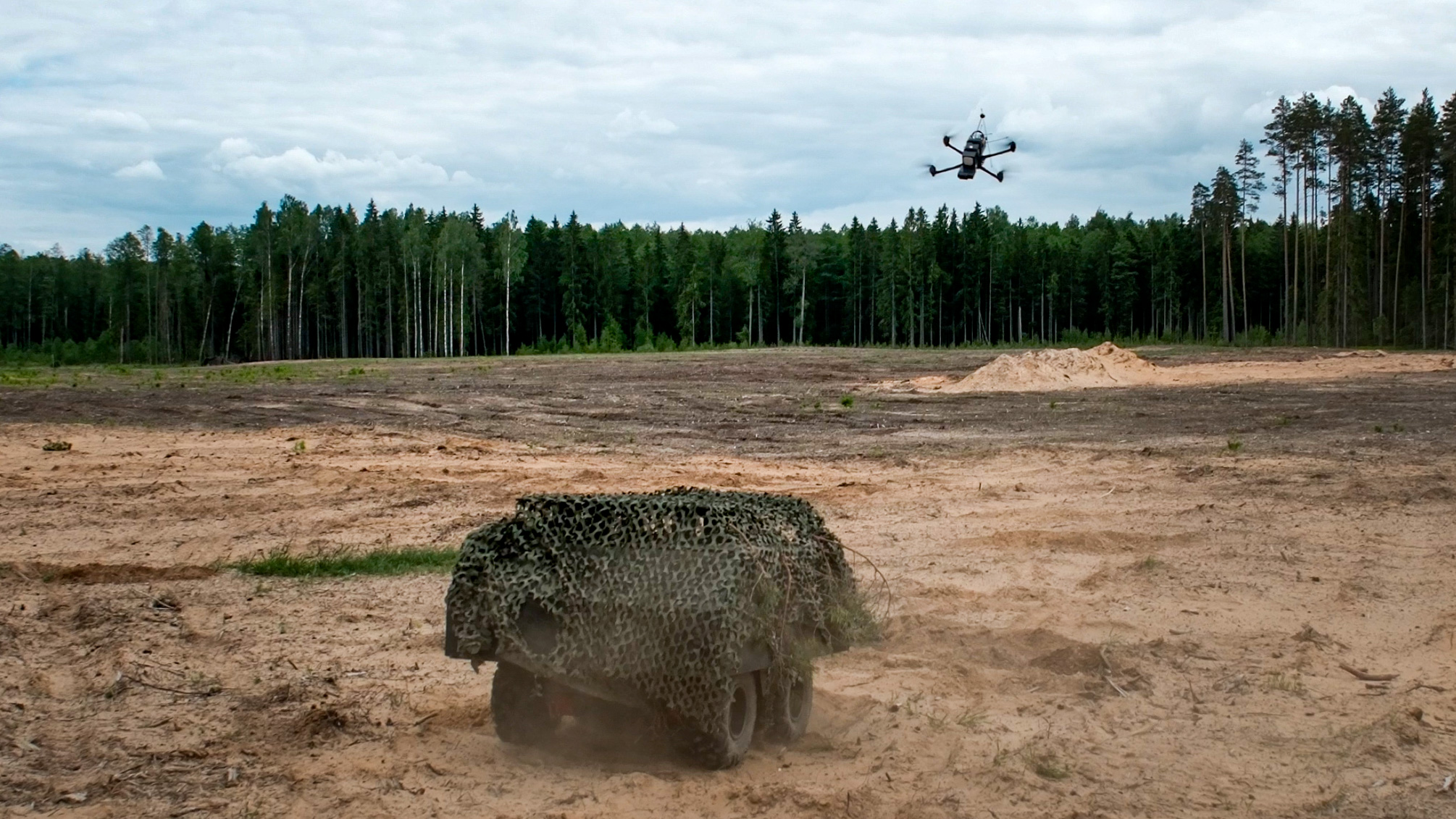
Selonia area is the largest military training ground in the Baltics. The trainees operated under field conditions simulating realistic operational environments. They carried out exercises against static and moving targets, including engagement in trenches and in forests, and against mechanised manned and unmanned platforms such as unmanned ground vehicles (UGVs). In addition, they practised intercepting fixed-wing drones that mimic Russian one-way attack drones and carried out long-range operations over distances of several dozen kilometres. The training also included night operations and the use of thermal imaging systems.
"In this training area, we can conduct a wide range of exercises that are almost impossible in some other EU countries due to high population density and busy airspace,” said Major Modris Kairišs, Head of Latvian Autonomous Systems Competence Centre. “Latvia offers a unique opportunity to develop and expand this kind of test range. This is also why we have a lot of UAV producers in the country whose equipment can be used.”
The instructors from the Latvian Autonomous Systems Competence Centre designed the designed the exercises to make the trainees fulfil joint missions and stimulate collaboration.
“Training with operators from other EU countries is very important,” said a trainee from the Irish Armed Forces. “We share different experiences and build further cooperation. It’s also important to train in field conditions to properly learn how to operate the equipment.”
More European drone training and exercises
In parallel to the training, Latvia hosted EDA’s UAS Operational Users’ Symposium and Working Group. The event gathered over 40 military experts, industry representatives, and partner nations to discuss the design of a new EDA project that would deliver advanced UAS training courses across Europe. The project should build upon the experience from Ukraine and expand the initial one-time training course into a long-lasting European-level programme and network for military drone operations.
“The European Defence Agency developed a military helicopter training that became the Multinational Helicopter Training Centre in Portugal. That is our model,” said João Caetano from EDA. “For UAS, we also start with a joint and combined training, bringing together national expertise. Our objective is to build a network of training centres, a fully-fledged training programme, and integrate with existing exercises such as the Titan Sky.”
The UAS training in Latvia marks a significant step towards strengthening European defence cooperation and building a shared operational capability in unmanned systems.