European Commission, the European Defence Agency (EDA) and the Minister of Defence of Ukraine announced in Kyiv six winners of the first-ever BraveTech EU Phase I. EDA will now work with them to experiment with their solutions in realistic operational conditions under the BraveTech EU Phase II.
The winners successfully passed the BraveTech EU Phase I – intensive technology testing bootcamps that helped them progress with their innovative solutions. During the next phase, EDA will guide the companies to develop their technologies further, and experiment in a battlefield-like environment. The operational experimentation will take place in parallel to the EU OPEX in Portugal and will generate evidence to support further maturation of the technologies and potential military adoption.
"Innovation alone is not enough — it must be tested, trusted and rapidly turned into military capability,” said EDA’s Chief Executive André Denk at the award ceremony in Kyiv. “Through BraveTech EU, the European Defence Agency offers faster experimentation with operational rigour. By connecting innovation with real operational needs, we generate the trusted evidence that military users need to strengthen both Ukraine's immediate defence requirements and Europe's long-term defence readiness.”
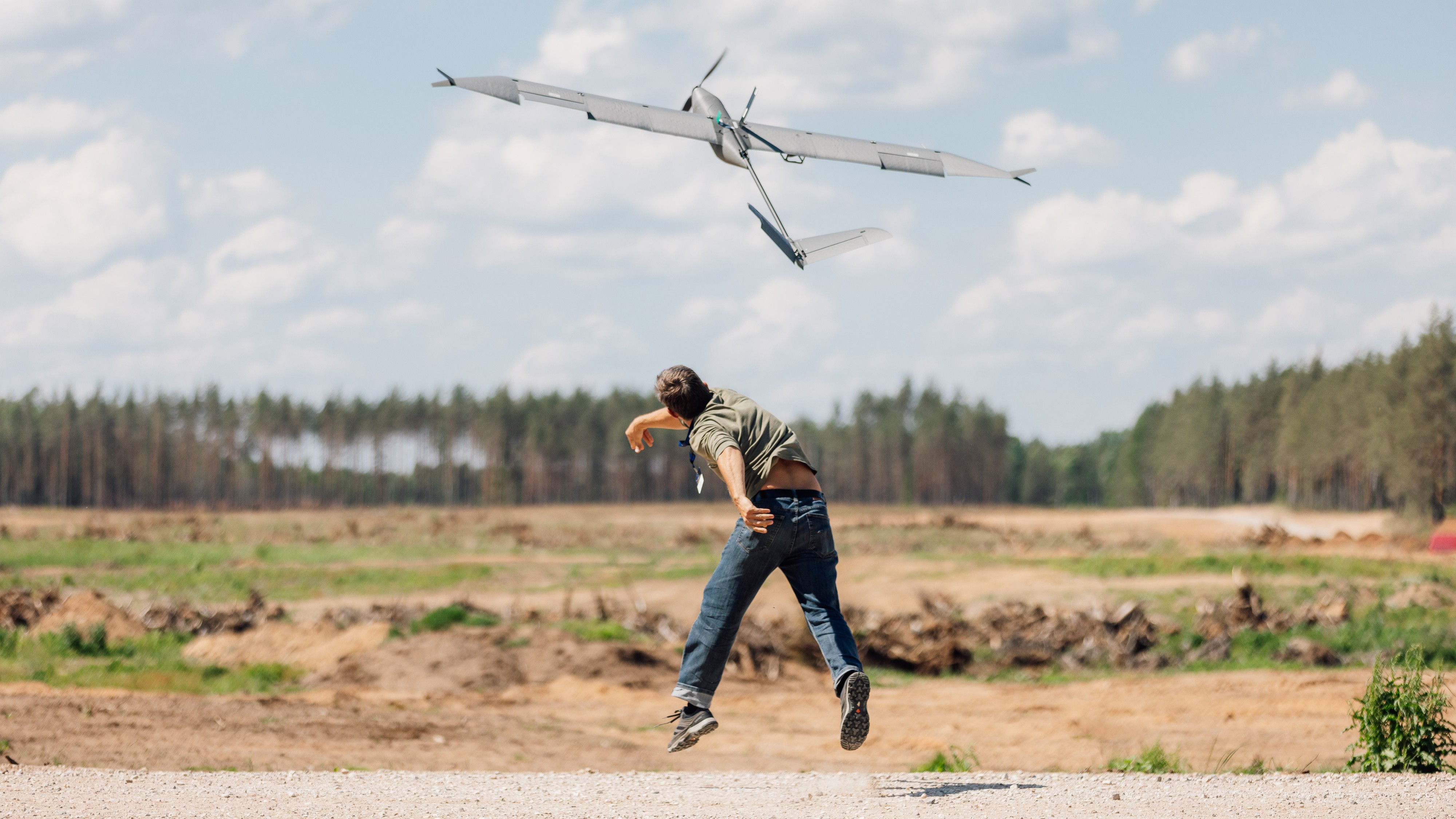
Testing of innovative drone technologies during BraveTech EU Phase I.
The companies selected for the BraveTech EU Phase II dedicated to experimentation are:
- Soraccel (France) - developer of complete multi-UAV systems, based on hierarchical drone swarms
- EdgeX Robotics (Poland) - modular unmanned ground vehicle (UGV) platform multi-role 4x4
- Smaesh GmbH (Germany) - multi-radio mesh, combining LoRa, Wi-Fi HaLow, Wi-Fi and BLE for resilient robotic and tactical connectivity
- Kova Labs (Finland) - cost-effective fully autonomous systems for complex low-altitude environments
- Tempterno Defence (Estonia) - multi-rocket launcher concept for counter UAS and land target engagement
- Rannon (Latvia) - rocket-propelled ammunition for drone-to-drone air combat
During Phase II, each company will demonstrate its solution against scenarios refined together with EDA and Portuguese Army experts. These include, for example, multi-drone reconnaissance missions, unmanned ground vehicle support tasks, or maintaining connectivity under deliberately degraded conditions. The companies will have the opportunity to operate their systems alongside EU OPEX participants.
After the campaign in Portugal, four most advanced technologies from BraveTech Phase II will continue the experimentation in 2027.
About BraveTech EU
BraveTech EU aims to accelerate defence innovation by building on battlefield challenges and strengthening cooperation between the EU and Ukraine. It brings together the European Commission, the European Defence Agency and Ukraine’s BRAVE1 Defence tech platform. The initiative runs multiple cycles between 2026 and 2028.
EDA is responsible for BraveTech EU Phase II with the total budget of €35 million until the end of 2028. The Agency’s role is to organise experimentation of the promising solutions in realistic conditions, with military expertise from Ukraine and EU Member States, so that innovation becomes trusted, scalable and usable. Through this structured approach, the Agency helps EU Member States and Ukraine increase their defence readiness and stimulate future capability development.